The Cult of Cá Ông: Understanding Cetacean Worship in Vietnam’s Coastal Villages
| ReviewCetacean worship Vietnam, known as the Cá Ông tradition, has shaped the lives of coastal fishing communities for at least three centuries and possibly much longer. While the Philippines and Japan are more widely associated with whale culture, Vietnam holds over 1,000 whale temples along its 3,260-kilometre coastline, making it one of the most active whale-revering nations on earth. Whale Island Resort sits on Hòn Ông, an island whose name translates directly as “Lord Whale’s Island” – the very language of this tradition inscribed into the geography of Van Phong Bay.
What is Cá Ông?
Cá Ông means “Lord Fish” or, more precisely, “Lord Whale.” The phrase uses the Vietnamese honorific Ông, meaning an elder male deserving deep respect: the same title used for a grandfather or a revered community leader.
In practice, Cá Ông refers to the belief that stranded or deceased whales are divine beings who have chosen a particular village as their final resting place. When a whale washes ashore, the fisherman who first spots it is considered to have been chosen by the spirit, and his family takes on the responsibility of conducting a formal funeral.
The tradition extends beyond whale death. Living whales sighted at sea are treated as protective omens. Fishing communities along the south and south-central coast believe that a whale swimming near a boat signals safety, guides the vessel away from storms, or leads crews to schooling fish. Boats in many coastal villages still have eyes painted on the prow — one explanation given by fishermen is that the eyes represent Cá Ông watching over the crew from the sea.
Where does the tradition come from?
The Nguyen Dynasty Decree (18th Century)
The most widely cited origin story involves Nguyen Anh, a southern warlord who would become Emperor Gia Long. Driven from his capital, Nguyen Anh was shipwrecked at sea and, according to tradition, rescued by whales that lifted his vessel and guided it to shore. On unifying Vietnam in 1802, he issued an imperial edict declaring all marine mammals sacred sea gods. He assigned the title Nam Hải Đại Vương (Great King of the Southern Sea) to the whale, and ordered coastal villages to build temples for worship.
The edict formalised a practice that already existed informally, providing it with official sanction and state resources.
The Buddhist Version
A second origin story, told along the central coast, describes the Bodhisattva of Compassion (Quan Âm) witnessing fishermen drowning in a storm. She tore her robe into thousands of fragments that transformed into whales, which carried the men to safety. In this version, whales are physical embodiments of divine mercy, and their bodies deserve the same reverence given to temples.
Cham Empire Roots (Pre-14th Century)
Researchers including Dr Vu Long of the Center for Biodiversity Ecology and Studies note that the tradition may predate the Vietnamese arrival in central Vietnam. The Cham people, who controlled this coast before the 14th century, held the whale spirit as “Po Riyah,” a master of the sea. When Vietnam expanded southward, it absorbed and adapted the Cham reverence rather than replacing it.
The Whale funeral ritual
When a whale strands on a Vietnamese beach, a precisely structured ritual begins:
- The fisherman who first spots the stranding becomes the “son of Cá Ông” and takes responsibility for the burial
- The whale’s body is laid on a flat wooden platform and wrapped in a red cloth shroud
- A procession forms, led by a drum band, a singing ensemble performing bà trao (traditional rowing songs), and flag bearers
- Permission is formally requested from the God of Earth before burial
- A three-year period of mourning begins, with incense burned continuously at the burial site
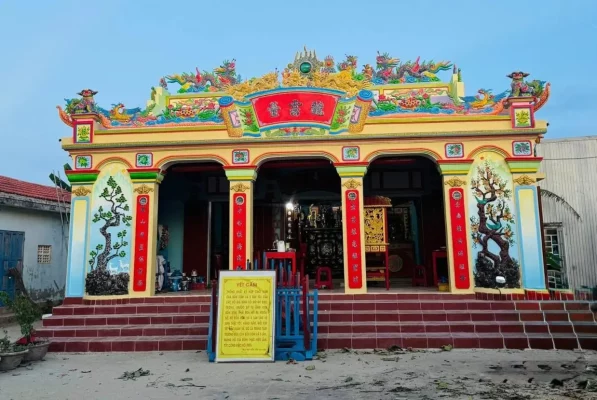
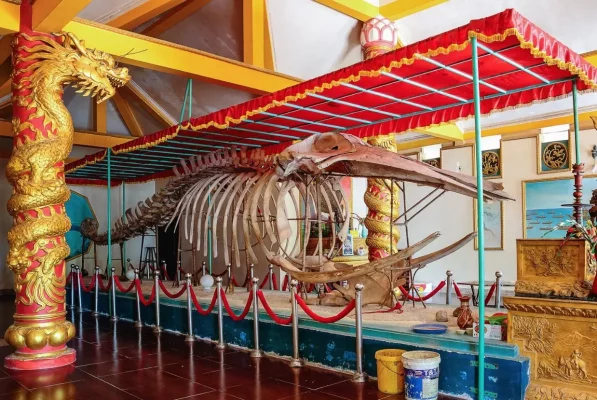
- After three years, the bones are exhumed, cleaned with rice wine or medicinal spirits, sun-dried, and placed in a lacquered coffin inside the Lăng Ông (Lord Whale’s Temple)
- The fisherman conducts anniversary offerings on the 49th day, 100th day, one-year and three-year anniversaries, exactly as he would for a deceased grandparent
Mr. Nguyen Van Quang (62 years) – one temple caretaker in Phước Hải told Al Jazeera: “When a whale is departing this world, we let it be. We play drums and gongs to help his soul leave peacefully.”
Offerings at whale funerals and subsequent ceremonies never include seafood. The logic is direct: whale gods live in the sea and protect the fish; serving their sacred domain’s creatures as food would be a profound disrespect.
The Nghinh Ông Festival
The Nghinh Ông festival (literally “Welcoming the Lord Whale”) is the annual celebration of the Cá Ông tradition. Dates vary by village – most link the festival date to the anniversary of the community’s first recorded whale stranding. The eighth lunar month is common, placing the festival between September and October in the Gregorian calendar.
The festival runs for three days. At 4am on the first morning, community elders read the Văn Tê Ông Ngú ceremonial worship text before a decorated altar. A boat procession then carries the altar and senior village men four to five kilometres out to sea and back, symbolically escorting Cá Ông’s spirit home. Boat racing, folk singing, and communal games follow during the day.
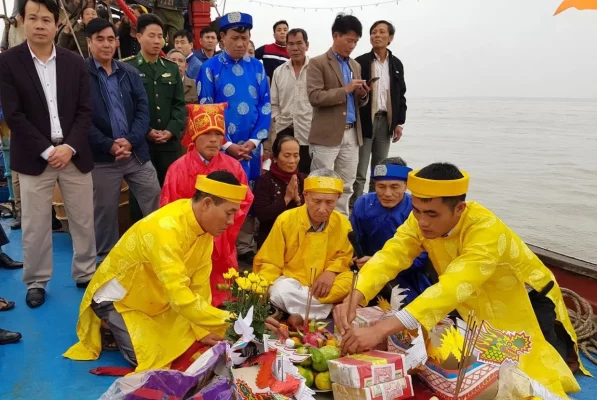
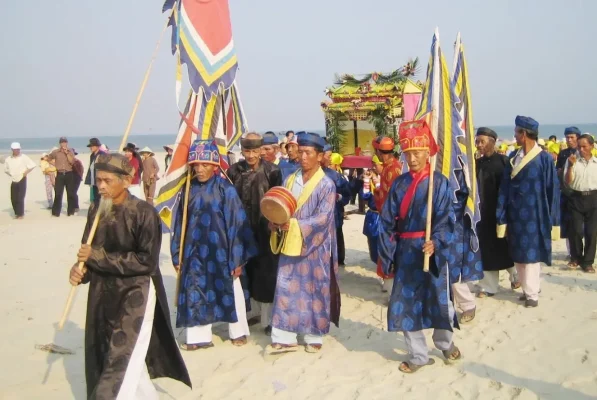
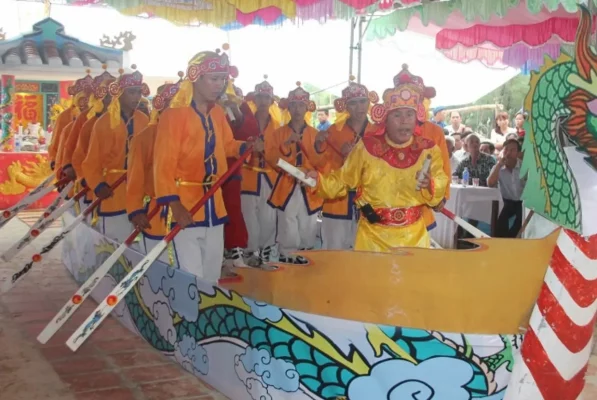
Only men over 60 who are still married may serve as ceremony leaders. Women who are menstruating or in mourning cannot attend. Fishermen observe a one-month break from offshore fishing immediately following a whale stranding in their village.
Hòn Ông: Where the name lives
The island on which Whale Island Resort is built is called Hòn Ông in Vietnamese. Hòn means “Island”. Ông, as established, means Lord – in this context, Lord Whale, Cá Ông himself.
The name is not metaphorical. Van Phong Bay and the waters around Hòn Ông (Whale Island) have been documented as areas where whale sharks gather seasonally (February to May) to feed on jellyfish and small shrimp. The fishing communities of the bay’s mainland villages, at Đầm Môn and in the Van Ninh area, have known this for generations. The name they gave the island is the oldest record of that knowledge.
Whale Island Resort acknowledges this in its own name. The resort’s English and Vietnamese identities are both rooted in the same tradition that produced a thousand temples along this coast.
Nguồn: Smithsonian Magazine — Inside Vietnam’s Whale Temples
📷 [Photo 3] File name: cetacean-worship-vietnam-3.jpg | Content: Sign or entrance to Whale Island Resort with island name visible, coastal setting, traditional elements in view
The scientific value of Whale Temples
Beyond their cultural significance, Vietnam’s whale temples are proving to be scientific resources of unexpected importance. Dr Vu Long’s research team has surveyed over 200 temples and identified skeletal remains from 25 cetacean species, including some rarely documented in Vietnamese waters.
As Vu Long told the Smithsonian: “Besides being a unique aspect of Vietnamese culture, whale temples are a great supplementary source of information for our research.”
A 2021 paper in the Raffles Bulletin of Zoology, co-authored by researchers from the Smithsonian Institution and the National University of Singapore, described Vietnam’s whale temple network as “a unique example of a cultural practice that has emerged as a result of interactions between marine mammals and humans… unique within Southeast Asia.”
The temples function as centuries-old specimen archives. Communities have preserved whale bones with meticulous care, creating a biological record that predates modern marine science.
📷 [Photo 4] File name: cetacean-worship-vietnam-4.jpg | Content: Researcher or documentarian examining whale skeleton in a Lăng Ông temple, bones visible in traditional housing, showing cultural-scientific intersection
FAQ
1. What is Cá Ông in Vietnamese culture?
Cá Ông translates as “Lord Whale.” It refers to the belief that stranded whales are divine sea gods who have chosen a village as their resting place. Vietnam has over 1,000 Cá Ông temples along its 3,260-kilometre coast, with the tradition strongest in south and south-central Vietnam.
2. Why do Vietnamese fishermen worship whales?
Tradition holds that whales protect fishing communities at sea, rescuing boats from storms and guiding them to safety. An 18th-century imperial decree by Emperor Gia Long formalised the worship, but the practice predates the Nguyen Dynasty, with possible Cham origins.
3. What is the whale temple in Vietnam?
A Lăng Ông (Lord Whale Temple) is a shrine housing the bones of a stranded whale, formally entombed after a three-year mourning period. Most fishing villages along the south-central coast have at least one; some temples contain remains from multiple whales spanning centuries.
4. What is the Nghinh Ông festival?
Nghinh Ông (“Welcoming the Lord Whale”) is an annual village festival marking the Cá Ông tradition. It involves sea processions, offerings, boat racing, and folk performances. The eighth lunar month is the most common time, though dates vary by village based on local whale stranding history.
5. Why is Whale Island Resort’s island called Hòn Ông?
Hòn Ông means “Lord Whale’s Island” in Vietnamese. The name reflects the centuries-old Cá Ông tradition practised by the fishing communities of Van Phong Bay, and refers to the documented seasonal presence of whale sharks in the bay’s waters.
Cetacean worship Vietnam is not a relic of distant history, it is a living practice in fishing communities from Đà Nẵng to Vũng Tàu, with temples still receiving offerings and festivals still drawing entire villages to the sea. The island where Whale Island Resort stands carries this tradition in its own name, making a stay there part of a cultural landscape that is as old as the fishing community it shelters.
📷 [Thumbnail] File name: cetacean-worship-vietnam-thumbnail.jpg | Content: Coastal fishing village scene with traditional boat and whale temple visible, blue sea in background, atmospheric and culturally rich
3D2N SUMMER ON WHALE ISLAND
From 126 USD USD/Guest/Combo
3D2N AUTUMN CALLS FROM WHALE ISLAND – NATIONAL DAY 2/9
From 118 USD/Guest/Combo